
How does a tensometer work in industrial applications?
In textile and garment manufacturing, product quality depends on more than how a material looks or feels. Fabrics, seams and bonded components must withstand the forces they experience during everyday use. But how can manufacturers measure this strength accurately before a product reaches the market?
This is where a tensometer becomes an important piece of testing equipment.
At Ardmel Automation, we understand the importance of reliable material performance. From seam sealing tapes and seam sealing machines to fabric testing equipment, we help manufacturers develop products that meet their performance requirements. A tensometer provides valuable data about how materials respond to force, helping manufacturers make informed decisions during product development and quality control.
In this guide, we explain how a tensometer works, its main industrial applications and why it is particularly useful for manufacturers working with technical textiles and seam-sealed products.

What Is a Tensometer?
A tensometer is a material testing machine used to measure the force required to stretch, tear or break a material. Depending on the equipment and test method, it can help determine tensile strength, breaking force and other mechanical properties.
Unlike visual inspections, which can only reveal visible defects, a tensometer provides measurable results that manufacturers can use to compare materials and assess their performance.
In textile manufacturing, this can be useful when testing:
- Fabric strength and resistance to tearing.
- The strength of stitched seams and textile constructions.
- Bonded materials and selected seam-sealed samples.
- Differences between fabric types or material batches.
- The breaking and tearing forces of materials during product development.
These measurements help manufacturers understand whether a material is suitable for its intended application and identify potential weaknesses before production moves forward.
How Does a Tensometer Work?
A tensometer works by securing a material sample and applying a controlled force until the sample stretches, tears or reaches a defined failure point.
Although the exact procedure depends on the machine and test method, the basic process involves four stages.
Preparing the Material Sample
The first step is to prepare a sample suitable for the intended test. This could be a strip of fabric, a stitched seam or a section of material incorporating seam sealing tape.
Sample dimensions, conditioning and preparation methods can affect the results, so these should follow the relevant testing procedure wherever applicable.
For manufacturers evaluating seam sealing performance, samples should represent the actual fabric, tape and application process used in production.
Securing the Sample
The prepared sample is positioned between the machine's grips or clamps. It must be held securely and aligned correctly to avoid unnecessary movement or uneven loading during testing.
Proper clamping is particularly important when working with flexible textiles, as slipping or incorrect alignment can affect the reliability of the results.
Applying a Controlled Force
Once the sample is secured, the tensometer applies a pulling force. The force increases according to the selected test procedure, placing the material under tension.
As the test progresses, the equipment measures the force applied to the sample. Depending on the machine's capabilities, it may also record displacement or extension.
The test continues until the required measurement is obtained or the sample reaches its failure point.
Recording and Interpreting the Results
The recorded measurements help establish how much force the material can withstand before tearing or breaking.
Manufacturers can compare these results across different samples, materials or production settings to identify differences in performance.
For example, if two fabric constructions look almost identical, tensile testing may reveal that one withstands greater force before failure. This information can help the manufacturer choose the more suitable material for the finished product.
What Is a Tensometer Used for in Industrial Applications?
Tensometers are used across industries where the mechanical strength and reliability of materials matter. Their value lies in providing objective measurements rather than relying solely on appearance or subjective assessment.
Textile and Garment Manufacturing
In textile production, a tensometer can assess the breaking and tearing forces of fabrics and other textile samples. This is useful when developing technical garments, sportswear, outdoor clothing and protective apparel.
Manufacturers can compare material options and investigate whether a fabric construction is suitable for the stresses associated with its intended use.
Seam Sealing Tape Testing
Seam sealing tapes are used to cover stitched seams and help prevent water from penetrating through needle holes. Their performance depends on several factors, including tape compatibility, fabric properties and the conditions used during application.
A tensometer can help evaluate the mechanical behaviour of selected seam-sealed samples. Depending on the test setup, it can provide useful information about the force required to separate, tear or break parts of a construction.
This can help manufacturers investigate weak points and compare alternative materials or application methods. Specific adhesive peel-strength tests may require an appropriate test configuration and procedure.
Quality Control
Consistent quality is essential when manufacturing products in large quantities. Testing representative samples can help manufacturers identify variations between material batches or production runs.
By comparing results against defined acceptance criteria, quality teams can investigate unexpected changes and take corrective action where necessary.
Research and Product Development
When developing a new garment or technical textile product, manufacturers may need to compare several materials before choosing the most suitable option.
A tensometer helps quantify differences in material performance, supporting decisions during prototype development and material selection.
Why Is Tensometer Testing Important for Seam Sealing?
A waterproof garment must do more than prevent water from passing through its fabric. Its seams also need to maintain their integrity during movement and use.
Seam sealing tape is commonly applied to stitched seams in waterproof jackets, outdoor clothing, sportswear, tents and other technical textile products. If a seam or bonded section cannot withstand the forces placed on it, the finished product may not perform as intended.
Tensometer testing helps manufacturers investigate the mechanical strength of these constructions before full-scale production.
For example, a manufacturer might compare samples prepared using two different seam sealing tapes on the same fabric. Testing can reveal differences in how the samples respond to force and help determine whether further investigation is needed.
If a sample performs poorly, the manufacturer can review factors such as:
- Tape and fabric compatibility: Whether the selected materials are suitable for use together.
- Application temperature: Whether sufficient heat was applied to activate the tape as required.
- Pressure and machine speed: Whether the application conditions were appropriate for the materials.
- Bonding consistency: Whether the finished sample shows reliable performance across repeated tests.
Tensometer results should be considered alongside other relevant checks. For waterproof garments, for instance, hydrostatic head testing can assess resistance to water penetration, while suitable adhesion and wash-durability tests can provide additional information about seam performance.
Together, these methods give manufacturers a more complete understanding of product quality.
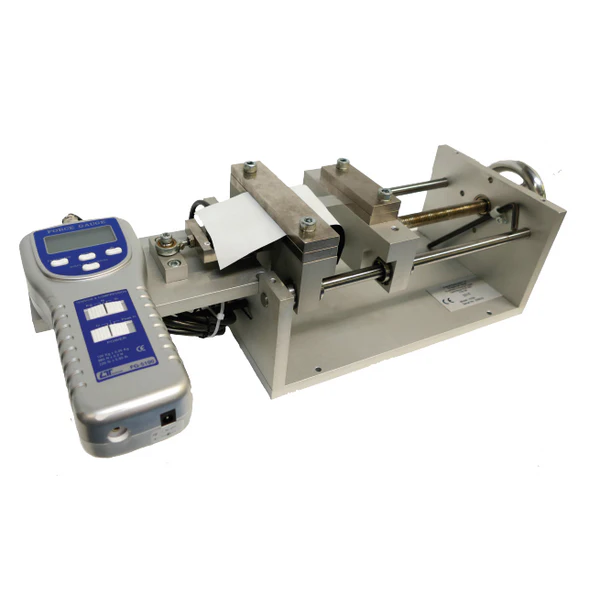
Meet the Ardmel TE-10 Tensometer
At Ardmel Automation, our TE-10 Tensometer is designed to make material testing practical for textile and garment manufacturers.
The portable testing machine measures breaking and tearing forces up to 980 newtons (N), helping users assess material strength and compare samples during quality control and product development.
Key features include:
- Portable design: Suitable for convenient testing in different working environments.
- Simple clamping system: Helps users secure samples and prepare tests efficiently.
- User-friendly controls: Supports straightforward operation without extensive training.
- Digital interface: Allows test results to be recorded and presented for easier analysis.
The TE-10 is suitable for applications including textile and garment manufacturing, research and development, quality control laboratories and comparative material analysis.
By providing measurable results, it helps manufacturers make more informed decisions about the materials they use and the performance they need to achieve.
How Do You Choose the Right Testing Equipment?
The right testing equipment depends on the material being assessed and the information you need to obtain.
Before selecting a tensometer, consider the types of samples you intend to test, the force range required, and the test methods relevant to your products. You should also consider how the equipment will fit into your existing quality control or product development process.
For manufacturers using seam sealing tapes and machines, it is worth considering how tensile testing fits alongside other material and waterproofness checks.
Choosing appropriate equipment and test procedures can help you establish meaningful performance benchmarks, investigate production issues and compare alternative material combinations.

Improve Your Material Testing with Ardmel Automation
Understanding material strength is an important part of producing reliable technical textiles. A tensometer provides measurable information about how fabrics and other materials respond to force, helping manufacturers make better decisions throughout product development and quality control.
At Ardmel Automation, we combine our expertise in seam sealing tapes, seam sealing machines and textile testing equipment to support manufacturers working towards consistent product performance.
Whether you are evaluating fabric strength, comparing materials or looking to improve your seam sealing process, our team can help you explore a suitable solution.
Contact Ardmel Automation today to learn more about our TE-10 Tensometer, seam sealing tapes and specialist machinery, and discuss the right testing equipment for your manufacturing requirements.